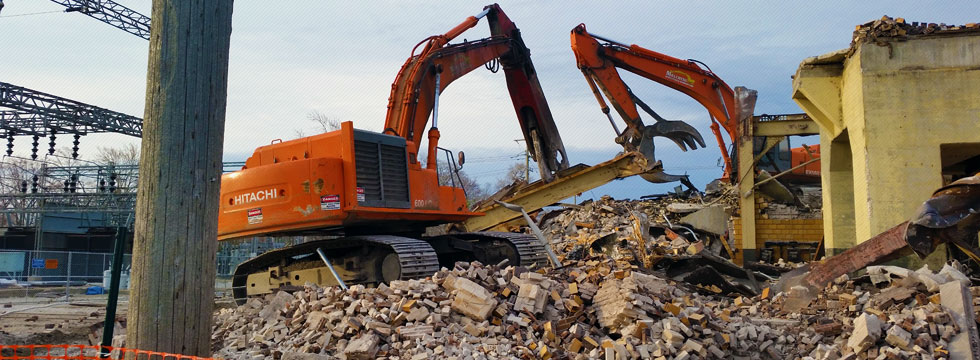
Melching supports active industrial facilities with selective demolition, environmental remediation, hazardous material abatement, salvage/recovery, site clearing, and preparation work. Our self-performing crews and owned equipment help facility teams address aging infrastructure, obsolete equipment, environmental concerns, and redevelopment needs without losing sight of safety, compliance, or ongoing operations.
Precision demolition for complex interiors.
When a facility needs to stay operational—or when a structure demands careful, surgical removal—Melching gets it done cleanly, safely, and without disrupting what’s working.
What We Do
Selective and interior demolition requires accuracy, planning, and a team that knows how to move through a facility without slowing the operation around it. Melching performs:
Selective & Interior Demolition
- Interior demolition
- Equipment and line removals
- Mezzanine, platform, conveyor, and support-structure removal
- Concrete cutting, removal, and crushing
- Structural separation and controlled demolition
- Demolition in occupied or active facilities
Environmental & Regulated Materials
- Environmental remediation
- Hazardous material abatement
- Asbestos / regulated material coordination
- Contaminated soil or material handling
- Proper disposal, recycling, and documentation
- Dust, debris, runoff, and site-control measures
Facility Support
- Site clearing
- Slab, foundation, and utility removal
- Trenching, backfill, and grading
- Emergency or priority response support
- Pre-renovation or pre-construction demo
- Shutdown / outage support
Salvage & Recovery
- Scrap metal recovery
- Equipment salvage
- Asset recovery
- Material separation and recycling
With in-house crews and equipment, we maintain tight control of safety, cleanliness, and project schedules from day one.

Want to understand the risks and details behind selective demolition?
Read our deep dive: Selective Demolition: What’s Easy to Miss and Why It Matters and learn the challenges, hidden hazards, and planning steps that protect your facility, your team, and your schedule.
Selective Demolition FAQs
What is selective demolition?
Selective demolition is the controlled removal of specific interior or structural elements while preserving the surrounding building. It’s used for renovations, reconfigurations, and upgrades inside active or partially occupied facilities.
How is selective demolition different from full demolition?
Selective demolition removes targeted materials, equipment, or systems without disturbing the rest of the structure. Full demolition removes the entire building, including foundations.
Can selective demolition happen in an active facility?
Yes. With proper isolation, dust control, and utility mapping, selective demolition can be performed safely in operating plants, hospitals, schools, and commercial buildings.
What materials or systems can be removed during selective demolition?
Common removals include interior walls, flooring, ceilings, MEP systems, equipment, tanks, mezzanines, process lines, utilities, and non-load-bearing structures.
How do you protect live utilities during selective demolition?
We verify all utility locations, confirm isolation points, install barriers, and coordinate directly with the facility team to ensure electrical, steam, water, gas, data, and mechanical systems remain protected.
Is selective demolition noisy or dusty?
Some noise and dust are unavoidable, but we use containment, negative air, filtration, and controlled work methods to minimize impact, especially in sensitive or occupied spaces.
Do you handle environmental hazards during selective demolition?
Yes. We identify and manage hazards like asbestos, lead, mercury, mold, and chemical residues. Proper containment, removal, and disposal follow all environmental regulations.
How much does selective demolition cost?
Costs depend on access, materials, utility complexity, environmental conditions, and cleanup requirements. A site assessment allows us to provide accurate, scope-specific pricing.
How long does selective demolition take?
Most selective demolition projects range from a few days to several weeks, depending on project size, site access, utility coordination, and environmental considerations.
What information do you need to start a selective demolition quote?
Helpful items include drawings, facility access details, environmental reports, known utility locations, and project goals. A walkthrough confirms the final scope.
Related Services
Structural Demolition
Structural Demolition
Read More
Industrial Facility Support & Selective Demolition
Industrial Facility Support & Selective Demolition
Read More
Power Plant & Industrial Decommissioning
Power Plant & Industrial Decommissioning
Read More
Controlled Demolition
Controlled Demolition
Read MoreREADY TO CLEAR THE WAY?
Melching is the Midwest’s trusted demolition and environmental contractor. From teardown to cleanup, we handle every phase safely, efficiently, and sustainably.
M-F – 8AM to 5PM
3662 Airline Rd.
Norton Shores, MI 49444

