
In demolition, the plan is only the starting point.
Even with thorough surveys, environmental reports, and pre-construction walkthroughs, large institutional buildings — especially hospitals built over multiple decades — almost always hold surprises.
The former Mercy / General Hospital project was a clear reminder of that reality.
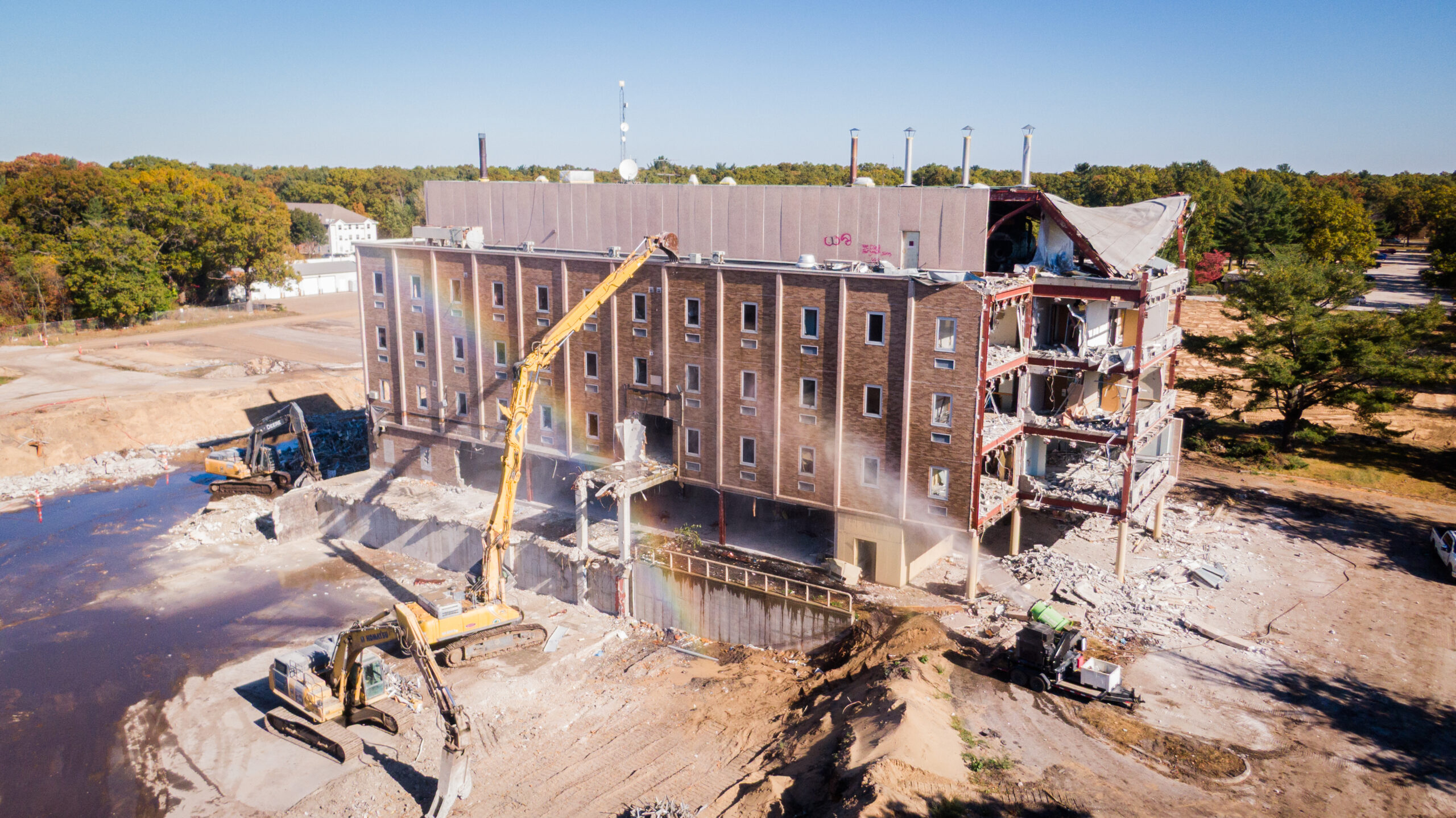
A Building Built in Layers
The facility was constructed in phases:
- A five-story patient tower from the 1950s
- A 1970s emergency room addition
- A 1990s OB wing
Our team approached demolition in reverse construction order, beginning with the newest section.
“We started with that nineteen-ninety section… it was abatement free… it was easy.”
Sequencing matters.
By starting in the abatement-free section, redevelopment activity could begin while environmental work progressed in older portions of the structure. That strategy preserved schedule momentum and reduced bottlenecks.
But the older sections told a different story.
When the Scope Changes Mid-Project
Hospitals built in the mid-20th century are synonymous with asbestos. Floor tile, mastic, pipe insulation, spray-applied fireproofing — it was widely used and deeply integrated into the structure.
“Asbestos is its own beast all by itself. That whole industry by itself is just an entire animal.”
The 1950s tower included spray-applied fireproofing in the penthouse — a heavily regulated material requiring full containment and constant perimeter air monitoring.
Containment was complex.
Air monitoring was continuous.
Third-party inspections were rigorous.
And then came the unexpected.
During foundation removal, the team uncovered a major unforeseen condition:
Approximately 2,000 additional tons of asbestos-containing material (ACM) on the perimeter concrete foundations — material not identified in the original documentation.
“We ran into a huge unforeseen condition… almost two thousand tons extra of ACM.”
That discovery significantly expanded the environmental scope, increased labor requirements, and extended the project timeline.
It also tested coordination, regulatory compliance, and field adaptability.
What Managing the Unexpected Really Means
Unforeseen conditions are not rare in demolition. The difference is how they are handled.
The process is disciplined:
- Stop and assess.
- Communicate clearly with stakeholders.
- Develop and implement a compliant remediation plan.
- Protect schedule integrity wherever possible.
This project required heavy containment measures, perimeter air monitoring, and strict third-party oversight throughout.
“Closed containment. Air monitoring on every individual plus perimeter air monitoring to ensure you are not contaminating the atmosphere.”
Despite the expanded scope and environmental complexity, the project was completed safely.
“Zero injuries.”
That is the benchmark that matters most.
Experience Makes the Difference
Phased demolition strategy.
High-reach equipment deployment.
Coordination around abatement teams.
Real-time schedule adjustments.
These decisions are informed by experience.
“Asbestos is an amazing product… but it’s its own animal.”
Hospitals are layered buildings. Every addition, renovation, and system change leaves a footprint. The older the structure, the greater the likelihood that something unexpected lies behind a wall or beneath a slab.
Managing that reality requires:
- Deep environmental knowledge
- Field-tested demolition sequencing
- Clear communication with owners
- A disciplined safety culture
- In-house crews capable of adapting in real time
The Bigger Lesson
Unforeseen conditions are not project failures.
They are project realities.
The true measure of a demolition contractor is not whether surprises occur — it’s whether the team can respond safely, compliantly, and professionally when they do.
The Mercy / General Hospital project was ultimately delivered shovel-ready for redevelopment, despite the discovery of significant additional ACM.
The building is gone.
The site is cleared.
The next chapter can begin.
That’s what responsible demolition looks like.

