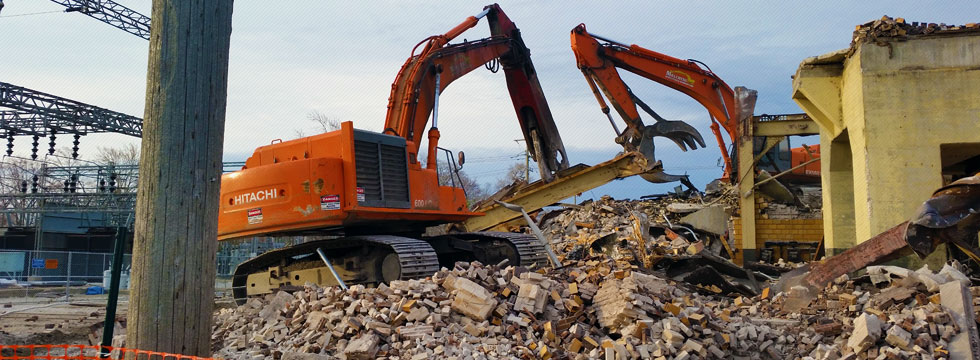
Industrial shutdowns without the chaos.
Industrial decommissioning requires far more than demolition, it demands a coordinated shutdown of systems, utilities, environmental hazards, and facility infrastructure. Melching decommissions factories, power plants, paper mills, refineries, utility sites, and high-risk industrial facilities with a fully self-performed approach that keeps safety, compliance, and efficiency at the center of every phase.
With decades of industrial experience and in-house crews who understand complex infrastructure, we manage each step of the decommissioning process to deliver clean, compliant, and redevelopment-ready sites.
Our Industrial Decommissioning Services
Decommissioning Support
- Pre-demolition planning support
- Site walks and constructability input
- Utility isolation / coordination support
- Hazard identification and sequencing
- Permitting and compliance coordination
Demolition
- Structural and selective demolition
- Stack, boiler, turbine hall, conveyor, and support-structure demolition
- Concrete removal and crushing
- Heavy equipment removal
Environmental & Regulated Materials
- Environmental remediation
- Contaminated soil handling
- Asbestos / regulated material coordination
- Proper disposal and documentation
- Recycling and waste management
Salvage & Recovery
- Scrap metal recovery
- Equipment salvage and asset recovery
- Material separation and recycling
Site Preparation
- Grading and backfill
- Site clearing
- Redevelopment readiness
- Shovel-ready closeout
We manage the entire shutdown process safely, efficiently, and in full compliance with MIOSHA, EPA, and EGLE requirements. Every project includes utility verification, environmental documentation, waste tracking, and coordinated communication with owners, consultants, and regulators.



Why Industrial Decommissioning Requires a Specialist
Industrial facilities contain interconnected systems, steam, electrical, chemical, mechanical, and process-specific infrastructure often installed over decades. Without proper sequencing and hazard identification, shutdowns can create:
-
Environmental releases
-
Utility backfeeds
-
Contamination spread
-
Fire or explosion hazards
-
Costly downtime or construction delays
Melching’s all-in-one model reduces these risks by combining demolition, environmental cleanup, and asset recovery under one experienced team with no subcontractor uncertainty.
Industrial Decommissioning FAQs
What is industrial decommissioning?
Industrial decommissioning is the process of safely shutting down, dismantling, and removing an industrial facility, including demolition, utility isolation, environmental cleanup, and asset recovery.
What types of facilities need decommissioning?
Facilities such as factories, power plants, paper mills, refineries, chemical plants, utility sites, and long-running industrial operations often require full or partial decommissioning.
What environmental hazards are involved in decommissioning?
Common hazards include asbestos, lead, PCBs, mercury, contaminated soil, tanks, residual chemicals, and hazardous building materials. These must be identified and removed under strict regulations.
What happens to equipment and scrap metal during decommissioning?
Equipment is evaluated for reuse, resale, or recycling. Scrap metals including steel, copper, and aluminum are recovered, sorted, and properly documented.
How do you safely shut down utilities and systems?
We perform utility mapping, verification, and isolation, followed by lockout/tagout procedures to ensure electrical, steam, gas, water, and process systems are safely disconnected.
How long does industrial decommissioning take?
Timelines vary based on facility size, system complexity, environmental conditions, and cleanup requirements. Most projects range from several months to a full year.
Do you provide environmental testing and disposal documentation?
Yes. We coordinate environmental testing, track waste streams, and provide complete documentation for regulatory agencies and owner records.
Can you prepare the site for redevelopment after decommissioning?
Yes. Melching provides concrete removal, crushing, grading, backfilling, and site preparation to deliver a clean, developable site ready for construction.
Is decommissioning different from demolition?
Yes. Decommissioning includes demolition but also requires system shutdowns, utility isolation, environmental remediation, and asset recovery — areas many demolition contractors do not handle in-house.
What information do you need to evaluate a decommissioning project?
Helpful materials include site history, environmental reports, utility maps, equipment inventories, and project goals. A site walk confirms the conditions and scope.
Want to understand the real challenges behind shutting down an industrial facility?
Read our in-depth guide: Inside Industrial Decommissioning: The Hidden Risks and How to Manage Them — and learn how proper planning prevents delays, environmental issues, and costly shutdown mistakes.
Related Services
Structural Demolition
Structural Demolition
Read More
Industrial Facility Support & Selective Demolition
Industrial Facility Support & Selective Demolition
Read More
Power Plant & Industrial Decommissioning
Power Plant & Industrial Decommissioning
Read More
Controlled Demolition
Controlled Demolition
Read MoreREADY TO CLEAR THE WAY?
Melching is the Midwest’s trusted demolition and environmental contractor. From teardown to cleanup, we handle every phase safely, efficiently, and sustainably.
M-F – 8AM to 5PM
3662 Airline Rd.
Norton Shores, MI 49444

